
MORE RESEARCH
Winning back lapsed members (a fascinating research study)
Researchers tested four win-back offers on 40,000 lapsed customers. Returning members were worth more than first-timers, and the cheapest offer won on ROI.
Member Retention

Steven Kryger

There are people who used to be members of your club who are no longer members. These people are a goldmine for membership growth for three reasons:
They are familiar with your club
They have demonstrated a need for what you offer
There are things you know about them to inform your approach
How do you win them back? This is what a research study sought to find out.
The researchers identified 40,000 lapsed members of a telco whose behavior suggested they were likely to return, then tested four different win-back approaches.
There are some great lessons here for member-based organisations (and a surprising statistic on ROI).
Who is likely to return?
Those who left over price are easier to win back than those who left over poor service. This makes intuitive sense. You can change your pricing, but rebuilding trust after a service breakdown is much harder.
They also discovered that:
Customers who had referred others during their first membership were most likely to return
People who'd never complained were excellent prospects
Even those who complained but had their issues resolved were prime for a comeback
Are they worth it?
The findings above might not be surprising. But this is:
Returning members stayed longer and spent more the second time around
That’s right - second-time customers in the study had an average lifetime value of $1,410, versus just $1,262 during their initial run with the service.
Which win-back offer works best?
The researchers tested four different strategies:
Come back and receive a discount
Come back and receive a service upgrade
Come back and get a discount and upgrade
Come back and receive an offer tailored to why you left
Here’s the results:
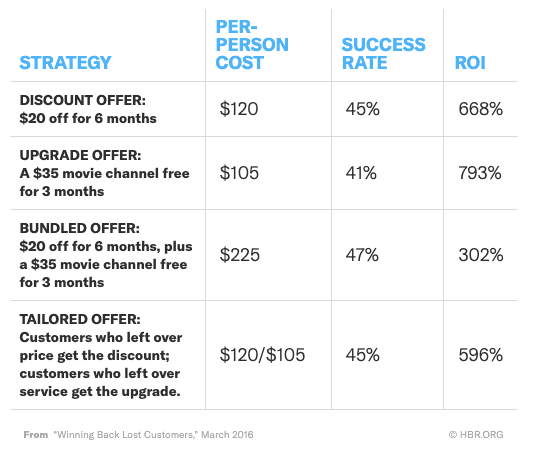
The bundled offer won on raw numbers, but here's the kicker: the standalone service upgrade, despite having the lowest success rate, delivered the highest return on investment.
5 lessons for membership organisations
Keep track of why members leave. This isn’t always easy and people won’t always tell you, but any data is helpful.
Don’t try to win-back everyone. Segment out those people who had a poor experience.
Tag members based on their experience. Simple tags such as “Bad customer experience” or “Resolved issue satisfactorily” will help to design custom offers.
Experiment with different offers. You’re not a telco and your members value different things. The only way to find out is to test and see.
Measure the response and the ROI. The numbers tell the story of what's working, allowing you to double down on successful strategies.
Ready to boost your win-back success? Instead of asking "How do we get more new members?", try asking "Which former members are most likely to return, and what would make them come back?"
There are people who used to be members of your club who are no longer members. These people are a goldmine for membership growth for three reasons:
They are familiar with your club
They have demonstrated a need for what you offer
There are things you know about them to inform your approach
How do you win them back? This is what a research study sought to find out.
The researchers identified 40,000 lapsed members of a telco whose behavior suggested they were likely to return, then tested four different win-back approaches.
There are some great lessons here for member-based organisations (and a surprising statistic on ROI).
Who is likely to return?
Those who left over price are easier to win back than those who left over poor service. This makes intuitive sense. You can change your pricing, but rebuilding trust after a service breakdown is much harder.
They also discovered that:
Customers who had referred others during their first membership were most likely to return
People who'd never complained were excellent prospects
Even those who complained but had their issues resolved were prime for a comeback
Are they worth it?
The findings above might not be surprising. But this is:
Returning members stayed longer and spent more the second time around
That’s right - second-time customers in the study had an average lifetime value of $1,410, versus just $1,262 during their initial run with the service.
Which win-back offer works best?
The researchers tested four different strategies:
Come back and receive a discount
Come back and receive a service upgrade
Come back and get a discount and upgrade
Come back and receive an offer tailored to why you left
Here’s the results:
The bundled offer won on raw numbers, but here's the kicker: the standalone service upgrade, despite having the lowest success rate, delivered the highest return on investment.
5 lessons for membership organisations
Keep track of why members leave. This isn’t always easy and people won’t always tell you, but any data is helpful.
Don’t try to win-back everyone. Segment out those people who had a poor experience.
Tag members based on their experience. Simple tags such as “Bad customer experience” or “Resolved issue satisfactorily” will help to design custom offers.
Experiment with different offers. You’re not a telco and your members value different things. The only way to find out is to test and see.
Measure the response and the ROI. The numbers tell the story of what's working, allowing you to double down on successful strategies.
Ready to boost your win-back success? Instead of asking "How do we get more new members?", try asking "Which former members are most likely to return, and what would make them come back?"


FOR MEMBERSHIP TEAMS
The Lab Report
New research and actionable ideas, once a fortnight.
Read by membership staff at clubs in the AFL, NRL, NBL and Super Rugby.


FOR MEMBERSHIP TEAMS
The Lab Report
New research and actionable ideas,
once a fortnight.
Read by membership staff at clubs in the
AFL, NRL, NBL and Super Rugby.
FOR MEMBERSHIP TEAMS
The Lab Report
New research and actionable ideas, once a fortnight.
Read by membership staff at clubs in the AFL, NRL, NBL and Super Rugby.
Get more members. Keep more members.
Get more members. Keep more members.
Get more members. Keep more members.